Pretrain
Initialize from Wan2.2-TI2V-5B. This stage reuses the pretrained weights without additional training.
PrimeSim.
From actions to visual consequences.
A video backbone, reworked into an action-conditioned,
multiview, causal simulator of robot manipulation.
¹ PrimeBot Research ² Southeast University ³ Shanghai Jiao Tong University
⁴ The Chinese University of Hong Kong ⁵ University of Chinese Academy of Sciences ⁶ Beihang University
⁷ Peking University ⁸ Shanghai Innovation Institute
Correspondence: travisdavies@qiyuan-robot.com
Weights link will be added at release.
Explore the research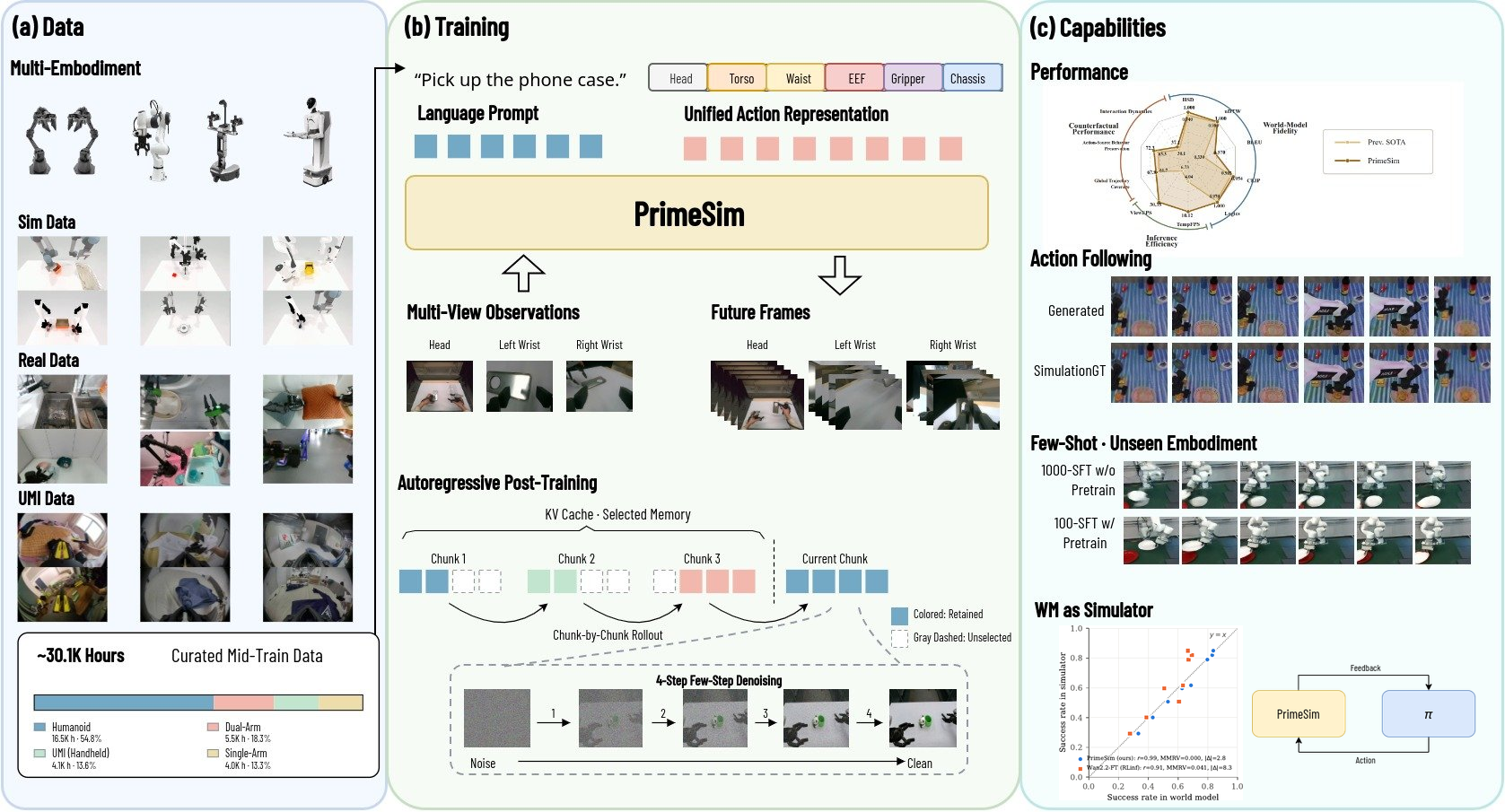
Across 22 robot platforms
Three synchronized views · single A100 · 288 × 384 / view
Gradient steps to action-following rollouts
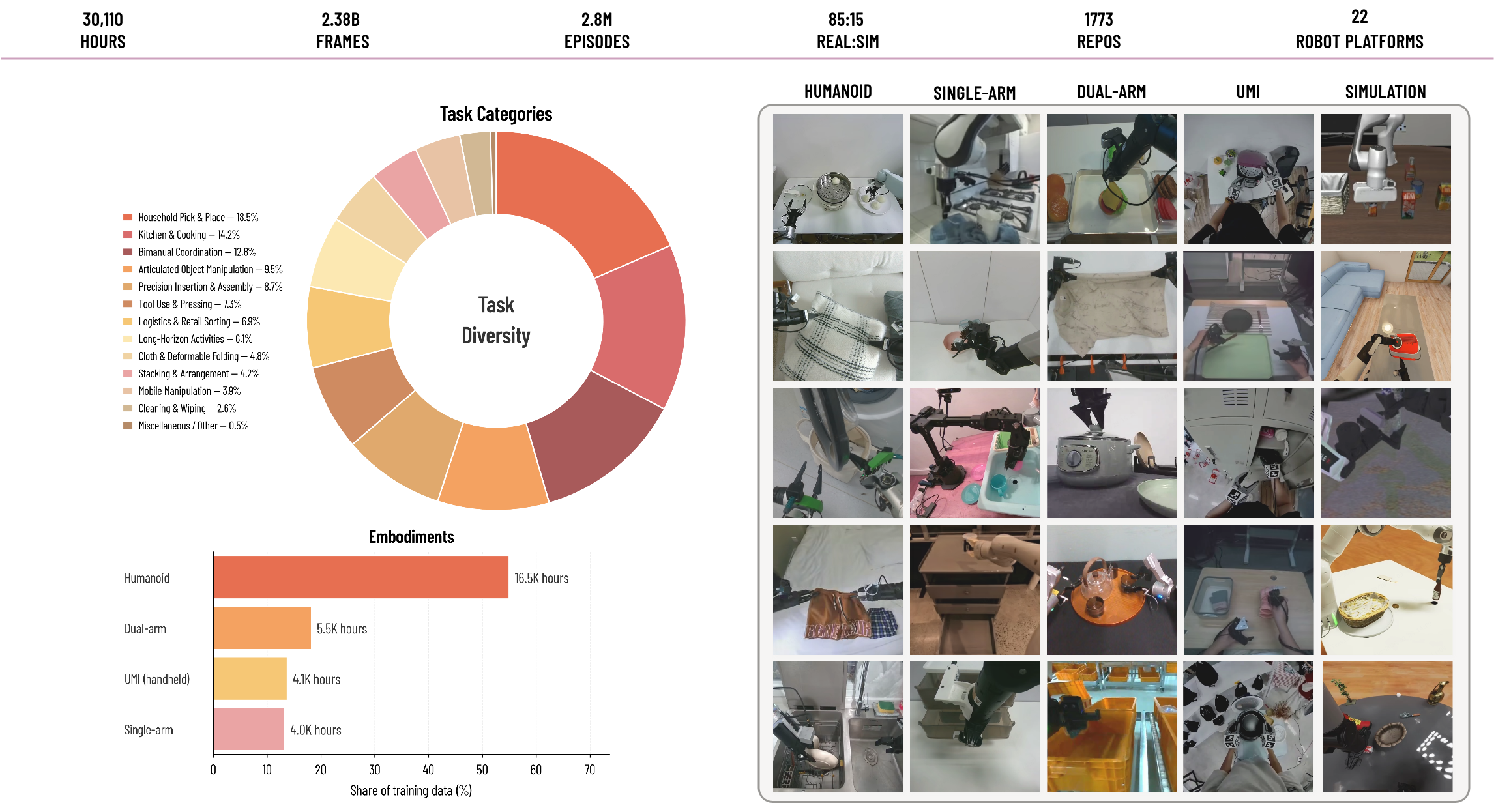
A robot world model that serves as a simulator must do more than generate plausible videos: it must faithfully follow commanded actions, maintain consistency across camera views, and sustain coherent long-horizon rollouts. We present PrimeSim, an action-conditioned, multiview world model simulator that addresses these challenges through progressive midtraining and posttraining.
Starting from a pretrained video generator, we midtrain on 30,110 hours of robot demonstrations spanning 22 platforms. To improve action following, we introduce a unified cross-embodiment action representation and frame-aligned dual-path conditioning to strengthen action–frame correspondence. To maintain multiview consistency, we develop view-aware interleaved attention with explicit camera identities, enabling cross-view information exchange while preserving view-specific representations.
We further introduce a fast-video, slow-memory posttraining framework that transforms the bidirectional video generator into an efficient autoregressive simulator. By combining fast causal generation, self-rollout training, and hierarchical temporal memory, PrimeSim mitigates error accumulation from self-generated histories and supports coherent long-horizon simulation.
PrimeSim runs at 10.1 FPS, maintains coherent rollouts for up to 105 seconds across rigid and deformable manipulation tasks, and transfers to held-out platforms within 100 to 200 gradient steps where the pretrained backbone does not. Against five open-source action-conditioned world models it leads four of the five WorldSimProbe suites and posts the best overall EWMBench score, while fine-grained local calibration still trails the field; its rollouts are faithful enough to support GRPO-based policy optimization. We release the model weights, inference code, and training code.
On three held-out platforms, the midtrained model reaches action-following rollouts within 100–200 gradient steps at a learning rate of 3 × 10⁻⁵. The pretrained Wan2.2 backbone does not reach this behavior within the 2,000-step budget.
Swipe to compare all three videos →
Swipe to compare all three videos →
Swipe to compare all three videos →
| Platform | Morphology | Midtrained steps | Pretrained steps |
|---|---|---|---|
| xArm 7 | 7-DoF single arm | 200 | 2,000 · not reached |
| ViperX 300 | Bimanual | 100 | 2,000 · not reached |
| UMI gripper | Handheld | 200 | 2,000 · not reached |
Each video shows a ground-truth trajectory on the left and a zero-shot generated rollout on the right. No gradient steps were used for these outputs.
| Data | Regime | PSNR ↑ | SSIM ↑ | LPIPS ↓ |
|---|---|---|---|---|
| XR2 | in-distribution | 19.79 ± 1.64 | 0.731 ± 0.053 | 0.192 ± 0.052 |
| XVLA | zero-shot | 15.82 ± 2.24 | 0.762 ± 0.049 | 0.297 ± 0.072 |
| Δ | −3.97 | +0.031 | +0.105 |
Both rows share the same checkpoint and sampler (50 steps, seed 42); only the data differs. XR2 uses held-out episodes of repositories seen in pre-training; XVLA is excluded and differs in scene, garments and camera placement. Means ± std over eight validation windows. SSIM is not comparable across the two datasets, so read PSNR and LPIPS as the degradation. Finetuning for 200 steps at batch size 1 recovers most of the gap.
Initialize from Wan2.2-TI2V-5B. This stage reuses the pretrained weights without additional training.
Learn action and multiview conditioning on 30,110 hours of robot demonstrations. Frame-aligned dual-path conditioning strengthens action–frame correspondence; view-aware interleaved attention with explicit camera identities exchanges information across views while preserving view-specific representations.
Turn the model into a causal, few-step generator. Use rank-32 LoRA with a frozen backbone.
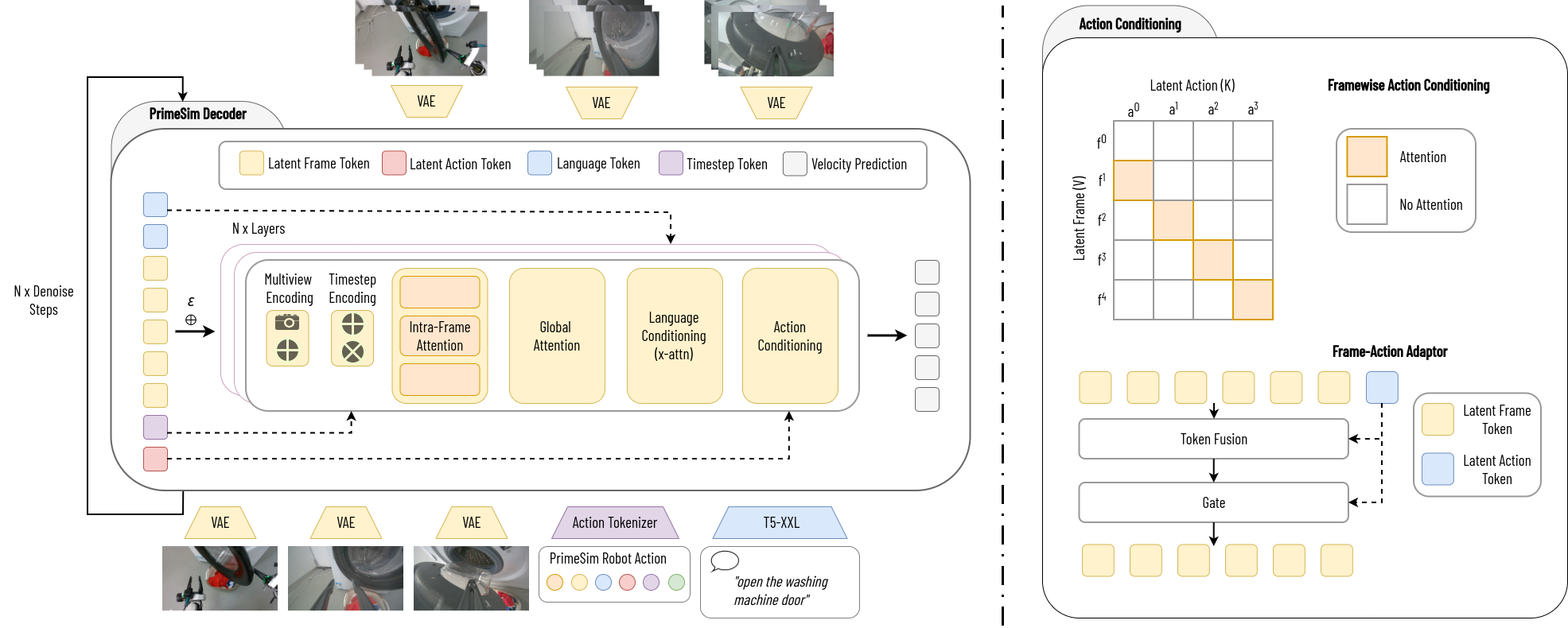
A 50-step teacher is distilled to a 4-step student, cutting latency roughly 9×. Stage-4 hierarchical temporal memory keeps a bounded KV cache of 21 latent slots: global sink 3, slow memory 9, local memory 9.
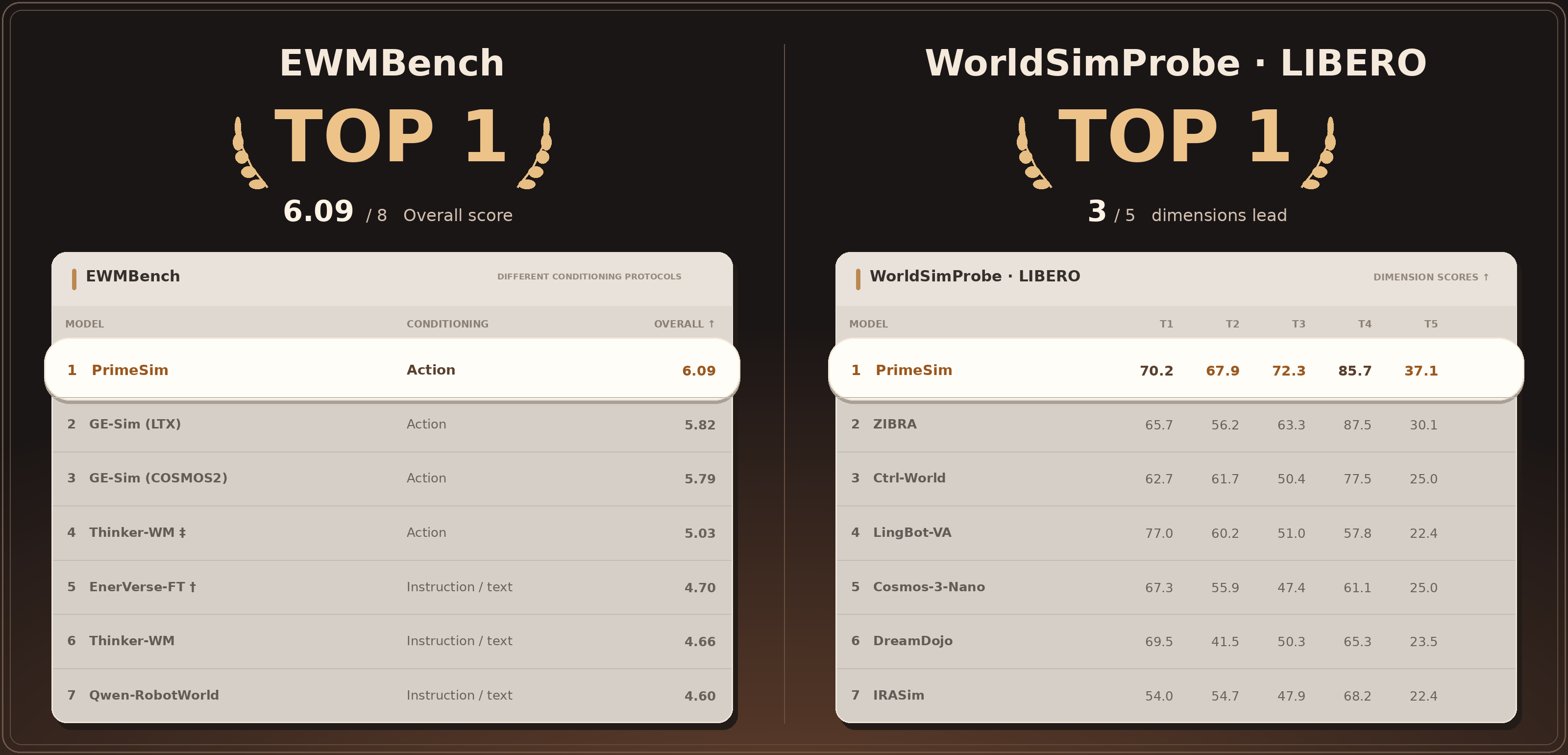
Against five open-source action-conditioned world models, first on four of five suites: global trajectory coverage (+10.0% over the strongest competitor), action-source behavior preservation (+41.8%), and interaction dynamics (+48.4%), with interaction grounding also led at 85.7 against Ctrl-World’s 77.5.
Fine-grained local calibration still trails: T1 is 70.2 versus LingBot-VA’s 77.0.
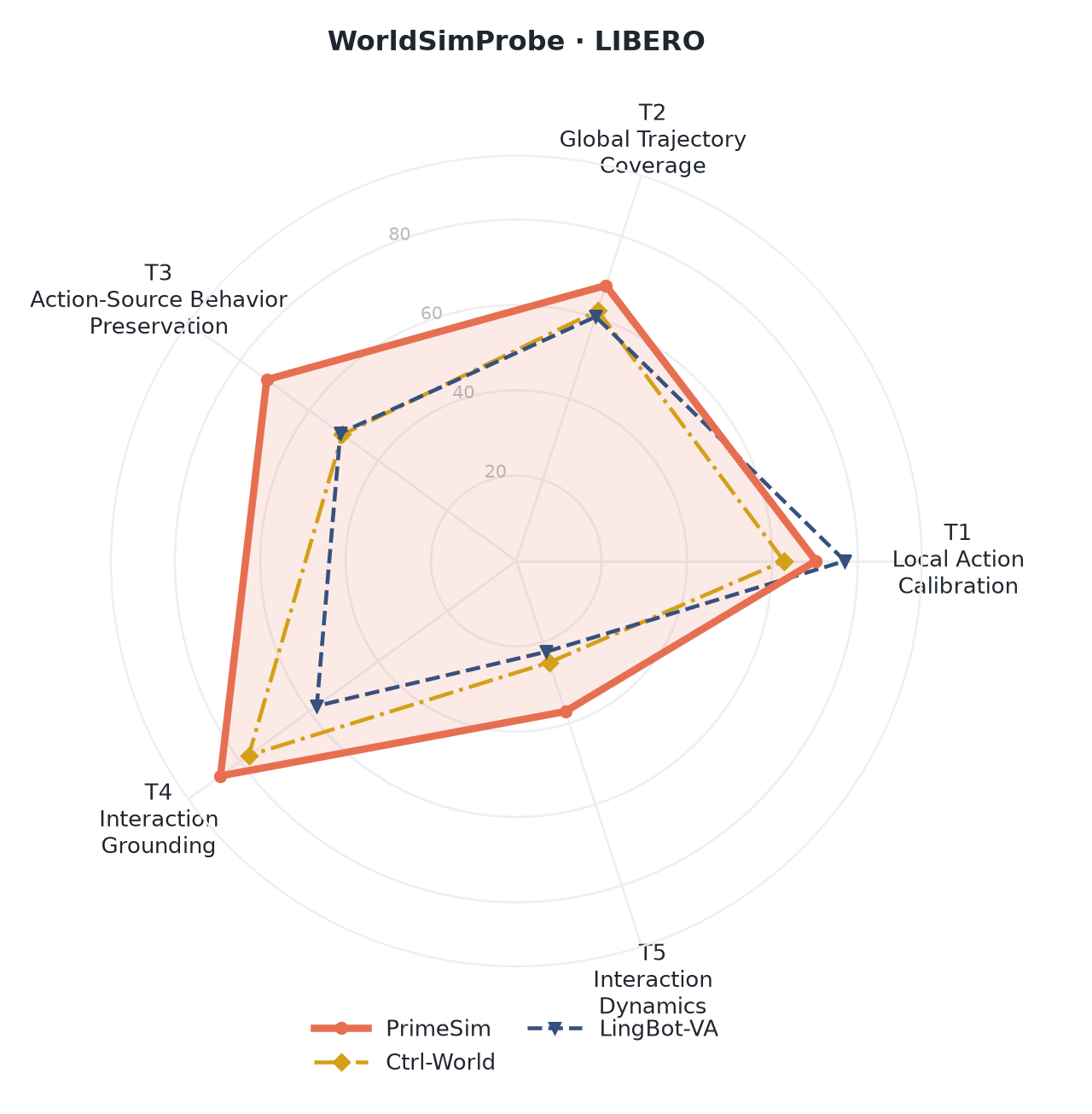
| Suite | Measure | PrimeSim | Best result |
|---|---|---|---|
| T1 | Local action calibration | 70.2 | 77.0 · LingBot-VA |
| T2 | Global trajectory coverage | 67.9 | 67.9 · PrimeSim |
| T3 | Action-source behavior preservation | 72.3 | 72.3 · PrimeSim |
| T4 | Interaction grounding | 85.7 | 85.7 · PrimeSim |
| T5 | Interaction dynamics | 37.1 | 37.1 · PrimeSim |
Twenty-one episodes across seven AgiBot World tasks, with multiple rollouts per episode under a fixed action-conditioned protocol and a small family of sampler settings. Overall is the sum of eight dimensions, each in [0, 1]. PrimeSim reaches 6.09, ahead of both GE-Sim variants (5.82 and 5.79) and every instruction-conditioned model, and is best on five of the eight dimensions, including perfect scores on high-level semantics, trajectory alignment and logical consistency. Action semantics (BLEU) is 72.7% above the strongest GE-Sim variant.
These episodes are in-domain: AgiBot World contributes to the training corpus, and the models compared here are fine-tuned from the midtrained checkpoint on these datasets before scoring. The numbers therefore measure how well the architecture absorbs an in-domain benchmark rather than zero-shot transfer to it; held-out platforms are evaluated separately under few-shot adaptation.
| Method | SceneC | HSD | Dyn | nDTW | Div | BLEU | CLIP | Logics | Overall |
|---|---|---|---|---|---|---|---|---|---|
| GE-Sim (LTX) | 0.900 | 0.940 | 0.780 | 0.980 | 0.011 | 0.330 | 0.908 | 0.970 | 5.82 |
| GE-Sim (COSMOS2) | 0.910 | 0.870 | 0.850 | 0.970 | 0.010 | 0.310 | 0.902 | 0.970 | 5.79 |
| Thinker-WM (action-cond.) † | — | 0.737 | 0.364 | 0.874 | — | — | — | — | 5.03 |
| PrimeSim | 0.887 | 1.000 | 0.666 | 1.000 | 0.010 | 0.570 | 0.954 | 1.000 | 6.09 |
These quality results use 50 denoising steps at CFG 1.5, generating at 192 × 256 and scoring the head-camera stream at 480 × 640. The throughput results below use the four-step distilled Stage-3 sampler.
† Only motion dimensions and Overall are reported for this variant. The paper also lists six instruction- or text-conditioned models (EnerVerse-FT 4.70, Thinker-WM 4.66, Qwen-RobotWorld 4.60, LVP 4.05, Sora2 3.89, Kling26 3.85) in a separate block, which is not iso-protocol with action-conditioned models.
| Model | Views | Res. / view | Future T | Steps | TempFPS ↑ | ViewFPS ↑ |
|---|---|---|---|---|---|---|
| PrimeSim · Stage 3 | 3 | 288 × 384 | 32 (33) | 4 | 10.12 | 30.35 |
| GE-Sim 2.0 | 3 | 384 × 512 | 25 | 4 | 2.24 | 6.73 |
| BWM · fair-aligned | 1 | 384 × 512 | 25 | 50 | 4.04 | 4.04 |
| Ctrl-World | 3 | 192 × 320 | 5 | 50 | 0.87 | 2.60 |
| BWM · official | 1 | 672 × 896 | 48 | 50 | 0.75 | 0.75 |
| CausalWM ‡ | 1 | 480 × 640 | 25 | 4+4+4 | 0.66 | 0.66 |
TempFPS counts rollout time steps per second (Hz); ViewFPS sums frames across camera views. The chart below uses Hz for every model; PrimeSim’s 10.12 Hz is shown rounded to 10 Hz. Rows are not matched in resolution, horizon or denoising budget. PrimeSim is timed at 288 × 384 per view under the RoboTwin 2.0 Stage-3 contract, a different geometry from the 192 × 256 quality evaluations. Longer continuous-KV episodes measure 7.63 TempFPS. ‡ Text- and first-frame-conditioned, not action-conditioned.
| Stage | Steps | FPS ↑ | PSNR ↑ | SSIM ↑ | LPIPS ↓ |
|---|---|---|---|---|---|
| Stage 1 · causal AR teacher | 50 | 1.12 | 26.15 | 0.859 | 0.153 |
| Stage 2 · causal KV consistency distillation | 4 | 10.04 | 24.40 | 0.841 | 0.193 |
| Stage 3 · asymmetric DMD | 4 | 10.12 | 24.87 | 0.838 | 0.176 |
Relative to the 50-step causal Stage 1 teacher, four-step Stage 3 improves throughput by approximately 9.0×, at a 1.28 dB PSNR cost. Output resolution: 192 × 256 per view; three views generated jointly.
Evaluated rollouts run 610–1,046 generated frames, or 61.0–104.6 seconds at 10 FPS, with three synchronized views. The abstract reports coherent rollouts for up to 105 seconds across rigid and deformable tasks.
Ten episode-level held-out RoboTwin trajectories, initialised from the first ground-truth frame and then conditioned only on the model’s own generated history. Degradation is the first-window score minus the last-window score, sign-corrected so that lower is better for all three metrics.
| Stage | Mean PSNR ↑ | Mean SSIM ↑ | Mean LPIPS ↓ | Δ PSNR ↓ | Δ SSIM ↓ | Δ LPIPS ↓ |
|---|---|---|---|---|---|---|
| Stage 3 · clip self-rollout | 12.572 | 0.401 | 0.654 | 18.305 | 0.602 | 0.640 |
| Stage 4 · episode self-rollout | 18.709 | 0.695 | 0.403 | 8.427 | 0.120 | 0.233 |
Episode-level training improves every metric and cuts PSNR degradation from 18.3 dB to 8.4 dB. This is the evidence for the long-horizon claim; without it the claim would rest on architecture alone.
| Representation | PSNR ↑ | SSIM ↑ | LPIPS ↓ |
|---|---|---|---|
| Absolute action | 22.23 | 0.79 | 0.14 |
| Delta action | 21.34 | 0.81 | 0.18 |
| Relative action chunk | 24.56 | 0.84 | 0.13 |
All three variants are trained from the pretrained checkpoint rather than the midtrained one, so stronger priors cannot mask the contribution. Single embodiment, so the comparison does not measure cross-embodiment behaviour.
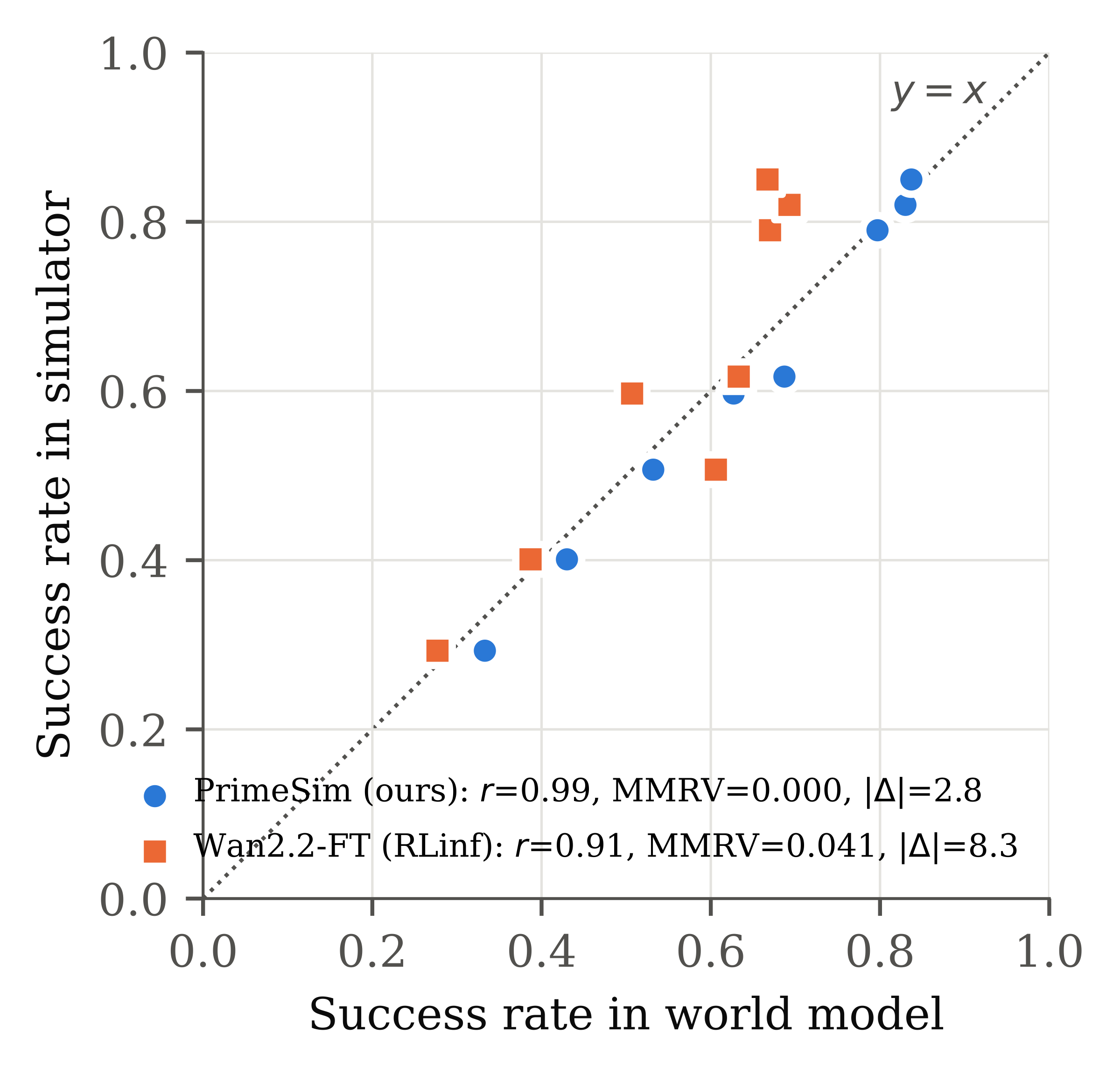
Video metrics measure how closely PrimeSim reproduces recorded trajectories. The relevant question for a simulator is whether conclusions drawn inside it carry over: whether it predicts and ranks the success of fixed policies as a physics simulator does, and whether it can serve as the training environment for RL post-training.
| Measure | PrimeSim | Wan2.2-FT |
|---|---|---|
| Spearman ρ ↑ | 1.00 | 0.90 |
| Pearson r ↑ | 0.99 | 0.91 |
| Mean absolute gap (points) ↓ | 2.8 | 8.3 |
| Worst per-policy gap (points) ↓ | 7.0 | 18.3 |
Policies are OpenVLA-OFT after supervised finetuning on LIBERO-Spatial demonstrations, predicting 8-step action chunks from the main camera view. Inside the world model, success is judged by a ResNet-based binary classifier finetuned on LIBERO-Spatial frames: an episode scores 1 if any generated frame is classified as success. PrimeSim orders all eight policies exactly as the simulator does and stays within 7.0 points of it for every policy. Wan2.2-FT tracks the trend but under-estimates the three strongest policies by 12.0, 12.7 and 18.3 points — the regime where checkpoint selection matters.
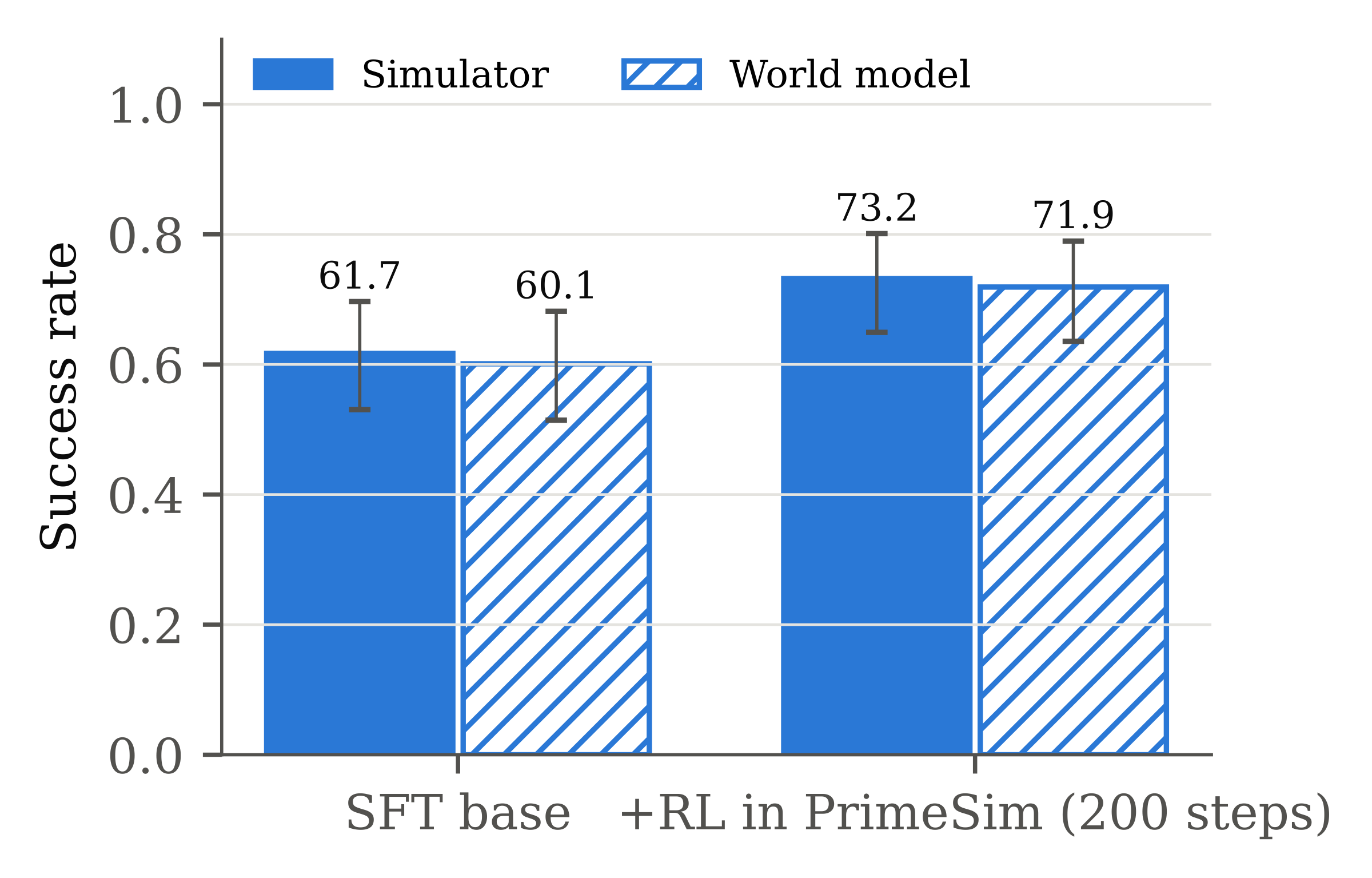
| Measure | SFT base | After 200 RL steps |
|---|---|---|
| Simulator success | 61.7% | 73.2% |
| World-model success | 60.1% | 71.9% |
| World model − simulator | −1.6 | −1.3 |
GRPO runs entirely inside PrimeSim: rollouts are generated closed-loop by the world model and scored by the success classifier, and the physics simulator is never queried during training. Imagined and true success stay within 1.6 points, so the improvement carries over. A short budget and an off-the-shelf classifier make this a demonstration that RL post-training works, not a success-rate claim; longer optimisation risks exploiting world-model or reward errors.
% The doubled braces around {PrimeSim} stop BibTeX styles from lowercasing it.
@misc{primesim,
  title = {{PrimeSim}: A Generalist World Model Simulator from Large-Scale Cross-Embodiment Demonstrations},
  author = {Davies, Travis and Ma, Wentao and Guo, Lihao and Ma, Tengfei and Chang, Xiaowen and Xu, Jiafeng and Wang, Shilong and Deng, Yiqi and He, Shaowen and Li, Xiaoqi and Zhu, Qian and Cheng, Ran and Dong, Hao},
  year = {2026},
  eprint = {2611.04870},
  archivePrefix = {arXiv},
  url = {https://arxiv.org/abs/2611.04870}
}